


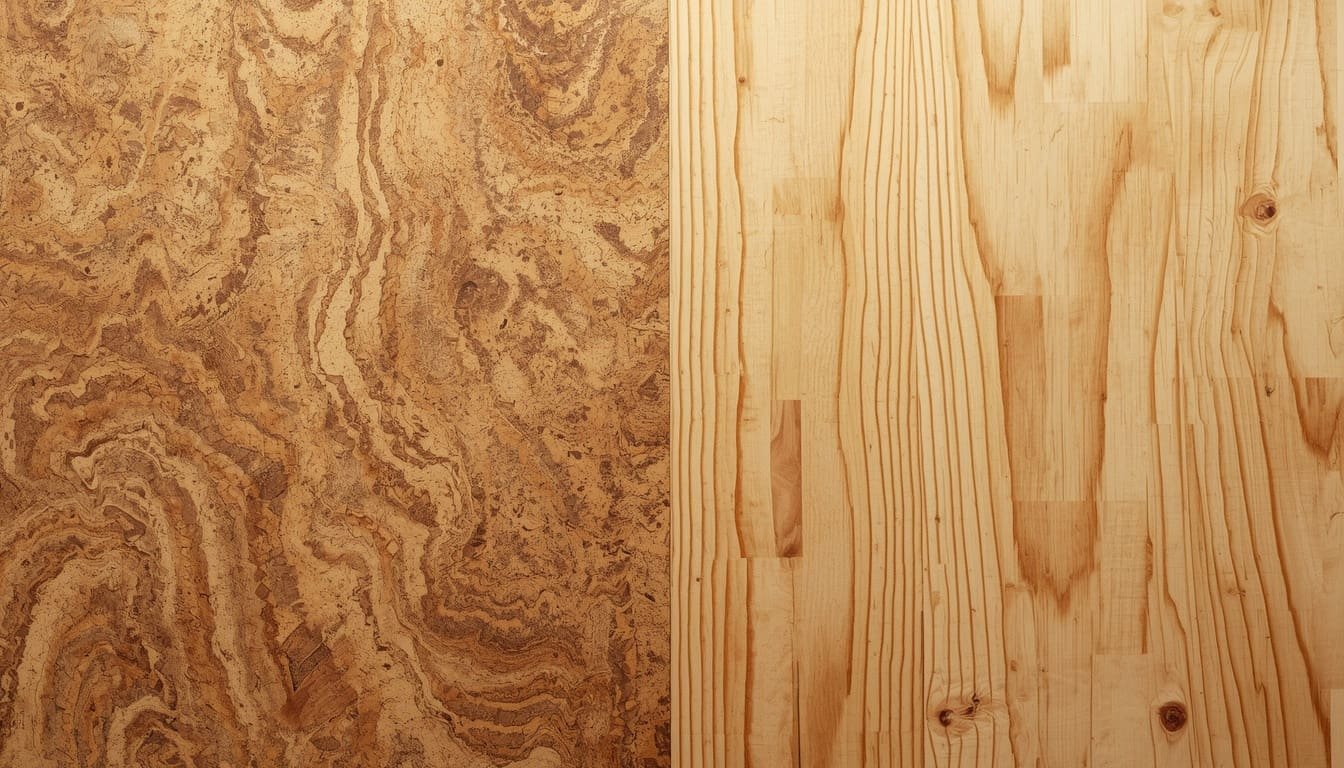
When comparing particle board vs plywood for kitchen cabinets, plywood is the better choice for most kitchens, especially cabinet boxes near sinks and dishwashers. It resists moisture more effectively and holds screws and hardware more securely over time. Particle board works well for budget-friendly projects, upper cabinets away from water sources, or interior parts that carry less weight. The right choice depends on your budget, kitchen layout, and how long you want the cabinets to last.
This guide breaks down the real differences between these two materials, so you can choose with confidence.
What Is Particle Board?
Particle board is an low-cost engineered wood product made from wood chips, sawdust, and shavings. Manufacturers bind these materials together with resin, then compress them under heat and pressure. The result is a dense, flat panel that costs less to produce than solid wood or plywood.
Cabinet makers often use particle board for interior shelving, cabinet backs, and lower-cost furniture. It has a smooth, uniform surface that takes laminate and veneer finishes well. This makes it a common choice for flat-pack furniture and budget kitchen lines.
What Is Plywood?
Plywood consists of thin layers of real wood veneer, glued together with the grain running in alternating directions. This cross-grain construction gives plywood its strength and stability. Manufacturers typically use 3, 5, or more layers, depending on the panel’s intended use.
Because plywood contains actual wood veneers, it holds screws better and resists warping. It also handles humidity changes more predictably than particle board. Most professional cabinet makers consider plywood the standard for cabinet boxes, especially in kitchens.
Particle Board vs. Plywood vs MDF vs OSB: Quick Comparison
| Feature | Particle Board | Plywood | MDF | OSB |
|---|---|---|---|---|
| Made From | Wood chips and sawdust bonded with resin | Thin layers of wood veneer glued together | Fine wood fibres bonded with resin | Compressed strands of wood bonded with resin |
| Strength | Low to moderate | High | Moderate | High |
| Moisture Resistance | Low | Moderate to high, depending on grade | Low to moderate | Moderate to high, depending on grade |
| Screw Holding | Fair | Excellent | Good | Good |
| Surface Finish | Smooth but porous | Natural wood grain | Very smooth and uniform | Rough, visible strand pattern |
| Cutting & Machining | Easy, but edges can chip | Easy to moderate | Easy and precise | Moderate; edges can splinter |
| Weight | Moderate to heavy | Moderate | Heavy | Heavy |
| Best For | Budget furniture, shelving, cabinet interiors | Cabinets, furniture, flooring, construction | Painted furniture, doors, decorative panels | Wall sheathing, flooring, roofing, structural applications |
| Cost | Low | Higher | Moderate | Moderate |
| Appearance | Plain, usually laminated or veneered | Natural wood appearance | Smooth, consistent appearance | Distinct strand appearance |
| Structural Use | Limited | Excellent | Limited | Excellent |
| Best Choice If You Want… | An affordable option | Strength and versatility | A smooth surface for painting | Structural strength at a reasonable cost |
Durability and Structural Strength
Plywood outperforms particle board in overall durability. Its layered construction distributes weight and stress across the panel, so it resists cracking and sagging under load.
Particle board is more brittle. It can crumble or break at the edges, especially if you drill into it repeatedly or move cabinets frequently. Heavy items like stacked dishes or small appliances put more strain on particle board shelves than on plywood shelves of the same thickness.
If you plan to store heavy cookware or appliances, plywood shelving reduces the risk of sagging over time.
Moisture Resistance
Kitchens involve constant exposure to water, steam, and humidity. This makes moisture resistance one of the most important factors in choosing cabinet material.
Plywood handles moisture better than particle board. While plywood can still swell if exposed to standing water for long periods, it dries out and often returns closer to its original shape. Particle board, on the other hand, absorbs water quickly and swells permanently. Once it swells, it rarely returns to its original form, and the damage is often visible.
This difference matters most under sinks, near dishwashers, and in cabinets close to stovetops where steam accumulates.
Weight-Bearing Capacity
Cabinet shelves and boxes need to support real weight: dishes, cookware, small appliances, and pantry items. Plywood shelves of the same thickness generally support more weight than particle board shelves before they start to bend.
Particle wood board can work for lighter storage, such as linens or lightweight plastic containers. For daily-use kitchen items, plywood offers a more dependable structural margin.
Screw and Hardware Holding Strength
Cabinet hinges, drawer slides, and handles rely on secure screw connections. Plywood holds screws firmly because of its layered wood grain. You can remove and reinstall hardware multiple times without significantly weakening the material.
Low-cost engineered wood holds screws less securely. Repeated removal and reinstallation of hardware can strip the material, especially near edges. Manufacturers often use specialized screws or inserts to improve holding strength in particle board, but plywood still performs better under repeated use.
Longevity
Plywood cabinets typically last longer than particle board cabinets, particularly in active kitchens. With proper care, plywood cabinet boxes can last 20 years or more. Particle board cabinets often need replacement or repair within 10 to 15 years, especially if they’ve been exposed to moisture or heavy daily use.
Appearance and Finish Options
Both materials accept laminate, veneer, and painted finishes well, so the visible difference in a finished kitchen is often minimal. Particle board provides a very smooth, consistent surface, which some manufacturers prefer for laminate application.
Plywood’s surface can show slight grain patterns under certain finishes, though this is barely noticeable once cabinets are installed. For most homeowners, appearance is not the deciding factor between these two materials.
Environmental Considerations
Particle board often uses recycled wood waste, which some homeowners view as a more sustainable option. However, the resins used in manufacturing can release volatile organic compounds (VOCs), so look for panels labeled low-VOC or CARB2-compliant if air quality is a concern.
Plywood production uses more raw wood material but generally involves fewer adhesives per panel. Many plywood products also carry FSC (Forest Stewardship Council) certification, which indicates responsibly sourced wood.
Neither material is clearly more sustainable in every case. The better choice depends on the specific manufacturer, certifications, and finishing materials used.
Cost Comparison
Cost is often the deciding factor for homeowners choosing between these materials.
Particle board typically costs 20% to 40% less than plywood for comparable cabinet sizes. A full set of particle board kitchen cabinets might run several hundred to a couple thousand dollars less than an equivalent plywood set, depending on kitchen size and finish quality.
Plywood costs more upfront but often costs less over time. Because plywood cabinets last longer and require fewer repairs, the higher initial investment can pay off, especially if you plan to stay in your home for many years.
If you’re renovating on a strict budget or plan to sell your home soon, particle board may make more financial sense. If you’re building a forever kitchen, plywood’s durability often justifies the higher price.
Where Each Material Works Best in a Kitchen
Not every part of a cabinet needs the same material. Many manufacturers mix both materials strategically to balance cost and performance.
Best uses for plywood:
- Cabinet boxes, especially base cabinets near sinks and dishwashers
- Shelving that holds heavy dishes or appliances
- Areas with frequent moisture exposure
- Drawer boxes that need strong joint connections
Best uses for particle board:
- Cabinet backs (rarely exposed to direct moisture or heavy weight)
- Upper cabinets storing lightweight items
- Interior partitions with minimal structural demand
- Budget-conscious projects where lifespan is a secondary concern
Many mid-range cabinet brands use plywood for the box structure and particle board for less critical interior components. This hybrid approach balances cost and durability.
How to Tell Which Material You’re Buying
Before purchasing cabinets, check the product specifications or ask the retailer directly. Look for these indicators:
- Weight: Plywood is generally lighter than particle board of the same size, due to its layered construction.
- Edges: Plywood shows visible wood grain layers at cut edges. Particle board shows a speckled, granular texture.
- Product labels: Many manufacturers list core material in the product description or spec sheet.
- Price: If a cabinet set seems unusually inexpensive compared to competitors, it likely uses particle board.
If you’re buying pre-made cabinets, don’t assume based on brand name alone. Even reputable brands offer both particle board and plywood lines at different price points.
Final Verdict: Particle Board vs Plywood, Which Should You Choose?
For most kitchens, plywood is the better long-term investment, particularly for cabinet boxes and areas exposed to moisture. It holds up better under daily use, resists water damage, and supports more weight without sagging.
Choose plywood if:
- You want cabinets that last 20+ years
- Your kitchen sees heavy daily use
- You’re installing cabinets near sinks, dishwashers, or stovetops
- You plan to stay in your home long-term
Choose particle board if:
- You’re working with a tight renovation budget
- You need cabinets for a rental property or short-term home
- You’re using it for low-moisture, low-weight applications like cabinet backs or upper shelving
- You plan to renovate again within 10-15 years
The best approach for many homeowners is a hybrid one: invest in plywood for cabinet boxes and high-moisture areas, and save money with particle board for less critical components.
Choosing between particle board vs plywood ultimately comes down to your budget, how you use your kitchen, and how long you want your cabinets to last. Understanding these differences helps you make a decision that fits your specific needs, rather than relying on price alone.
Frequently Asked Questions
Is IKEA kitchen cabinet furniture particle board or plywood?
IKEA uses a mix of both, depending on the product line. Their SEKTION cabinet frames use particleboard with a plastic foil finish, while some drawer boxes and higher-end lines incorporate plywood or solid wood components. Check individual product specs before purchasing.
Can particle board cabinets get wet?
It can handle brief, minor moisture exposure, but standing water or prolonged humidity causes it to swell and weaken permanently. Avoid using particle board in areas with direct water exposure, such as under sinks.
Does plywood cost significantly more than particle board?
Yes, plywood typically costs 20% to 40% more than particle board for comparable cabinet sizes. The price difference varies based on plywood grade, thickness, and finish quality.
Which material is better for cabinet doors?
Plywood generally performs better for cabinet doors because it resists warping from temperature and humidity changes. Particle board doors are more prone to swelling or sagging over time, especially in humid climates.
How long do particle board cabinets last?
With proper care and minimal moisture exposure, particle board cabinets typically last 10 to 15 years. Lifespan decreases significantly with water exposure or heavy daily use.
Also read:
