


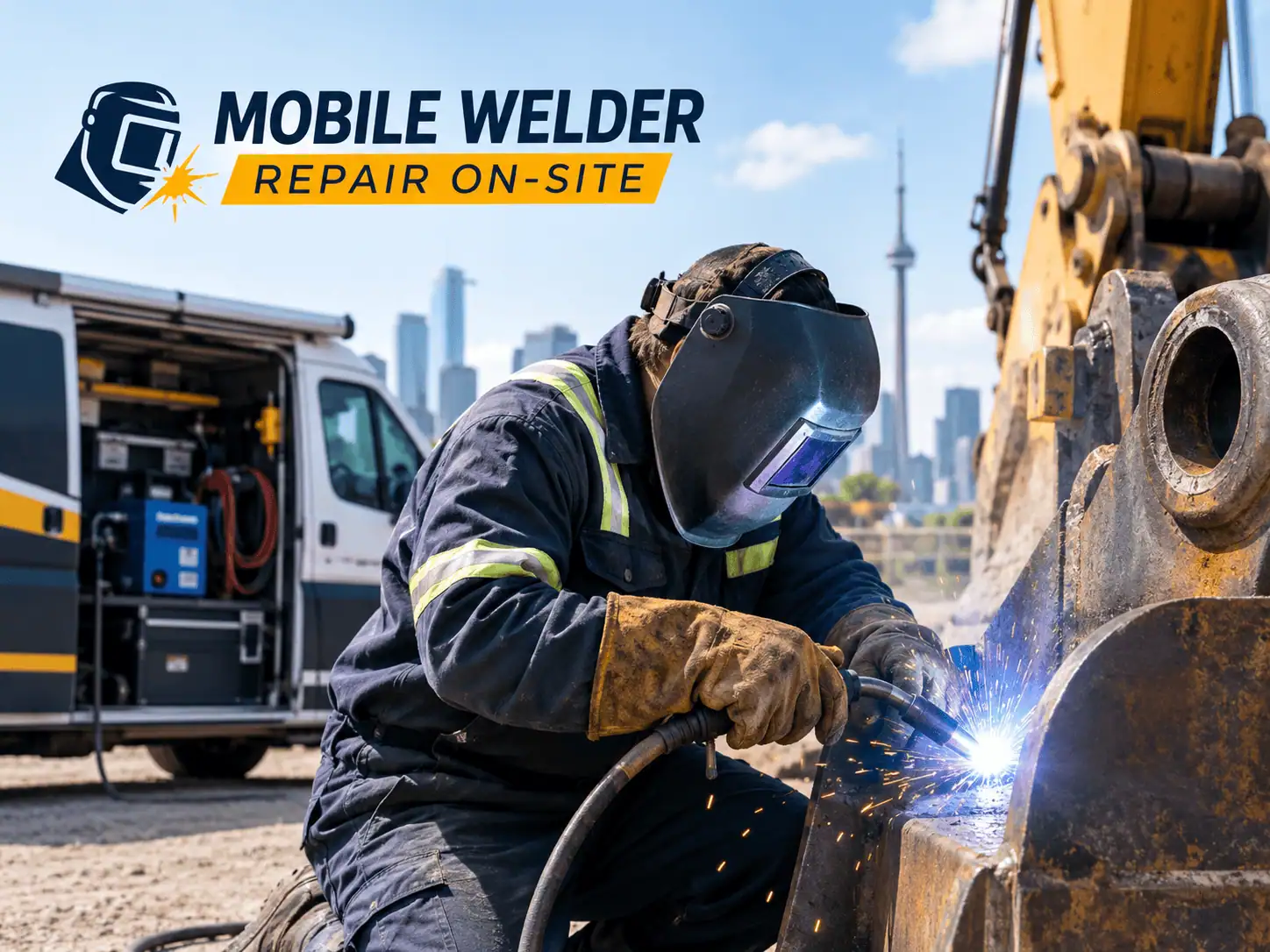
Steel structures, gates, trailers, equipment, and industrial machinery rarely fail at a convenient time. A cracked weld on a loading dock can delay deliveries, a broken railing can create a safety hazard, and damaged construction equipment can bring an entire project to a standstill. In many cases, transporting these items to a fabrication shop is impractical, expensive, or simply impossible. That’s where mobile welder becomes a practical solution.
Instead of dismantling heavy equipment or arranging costly transportation, a mobile welder travels directly to the job site with professional welding equipment, power sources, cutting tools, and safety gear. Repairs can often be completed where the equipment or structure is already installed, helping reduce downtime while restoring strength and functionality.
Mobile Welder Repairs: From Homes to Industrial Sites
Across the Greater Toronto Area (GTA), on-site welding is used by homeowners, commercial property owners, contractors, fleet operators, manufacturers, municipalities, warehouses, and agricultural businesses. From repairing ornamental iron gates in residential neighbourhoods to restoring structural steel at industrial facilities, mobile welding provides a versatile solution for a wide range of metal repair needs.
However, not every damaged item can, or should, be repaired on-site. Factors such as accessibility, material type, structural condition, safety requirements, and engineering specifications all influence whether a field repair is appropriate.
This guide explains:
- What mobile welding can repair
- When on-site repairs are the best option
- Situations where shop fabrication is more suitable
- Twenty-five real examples of common mobile welding repairs
- What to expect when hiring a mobile welder in the GTA
Whether you’re a homeowner dealing with a damaged gate or a facility manager responsible for industrial equipment, understanding the capabilities of mobile welding can help you make informed repair decisions.
What Is Mobile Welding?
Mobile welding is a professional service where certified welders travel to the customer’s location to perform welding, cutting, fabrication, reinforcement, or metal repair without requiring the workpiece to be transported to a welding shop.
Unlike traditional fabrication shops, mobile welding rig / truck are equipped to operate at:
- Residential properties
- Commercial buildings
- Industrial facilities
- Construction sites
- Warehouses
- Farms
- Manufacturing plants
- Transportation yards
- Municipal infrastructure
A typical mobile welding truck or trailer can carries equipment such as:
- MIG welders
- TIG welders
- Stick welding machines
- Engine-driven welders
- Plasma cutters
- Oxy-fuel cutting equipment
- Portable generators
- Grinders
- Magnetic drills
- Welding positioners
- Safety barriers and PPE
- Hand and power tools
This allows many repairs to be completed without removing heavy steel components or interrupting operations for extended periods.
Why On-Site Welding Is Growing Across the GTA
The Greater Toronto Area continues to experience significant growth in commercial construction, infrastructure upgrades, manufacturing, logistics, warehousing, and property development. As facilities become more complex and project schedules tighter, businesses increasingly rely on repair solutions that minimize downtime.
Consider a few common scenarios:
- A warehouse loading dock develops a cracked steel support during peak shipping hours.
- A property manager discovers loose balcony railings that require immediate attention.
- A contractor damages structural steel during renovation work.
- A trailer frame cracks while transporting equipment.
- A snow removal company experiences a broken plow mount during winter operations.
In each case, transporting the damaged component to a welding shop may involve cranes, flatbed trucks, equipment rentals, labour, and production delays.
A mobile welder brings the repair to the problem instead.
This approach often helps reduce:
- Equipment transportation costs
- Business interruptions
- Project delays
- Labour associated with dismantling equipment
- Safety risks caused by damaged metal structures
For many GTA businesses, every hour of downtime affects productivity. On-site welding offers a practical way to restore critical equipment more quickly than removing and reinstalling major components.
Can Everything Be Repaired On-Site?
One of the biggest misconceptions about mobile welding is that every broken metal component can simply be welded back together.
The reality is more nuanced.
An experienced mobile welder first evaluates whether the repair can be completed safely, effectively, and in accordance with applicable standards. In some situations, replacing the component or moving it to a fabrication shop is the better long-term solution.
Several factors influence this decision.
Accessibility
The damaged area must be accessible for proper preparation, welding, inspection, and finishing. Confined spaces, restricted clearances, or overhead hazards may limit what can safely be repaired in the field.
Structural Integrity
Not every crack is suitable for repair. If corrosion, fatigue, or impact damage has severely weakened the surrounding steel, simply welding over the crack may not restore the original strength.
In these cases, reinforcement, partial replacement, or engineered repairs may be necessary.
Material Type
Different metals require different welding procedures.
Mobile welders commonly repair:
- Carbon steel
- Stainless steel
- Aluminum
Certain specialty alloys or heavily heat-treated components may require controlled shop conditions.
Safety Requirements
Some environments require additional planning before welding begins.
Examples include:
- Fuel storage facilities
- Chemical plants
- Food processing facilities
- Active manufacturing lines
- Confined spaces
Proper isolation procedures, fire prevention measures, permits, and hazard assessments help ensure repairs are completed safely.
Engineering Requirements
Structural steel supporting buildings, mezzanines, platforms, or industrial equipment may require repairs that comply with engineering specifications or applicable welding standards.
In these situations, the repair process may involve consultation with engineers or inspectors before work begins.
How to Know Whether Your Item Can Be Repaired On-Site
Many property owners assume they need a replacement when a welded component fails. In reality, numerous metal structures can be restored safely if the damage is identified early.
Ask yourself these questions:
Is the damage localized?
If only one weld, bracket, hinge, support, or connection has failed while the surrounding metal remains sound, repair is often possible.
Can the welder safely access the damaged area?
If adequate working space exists for preparation, welding, and inspection, an on-site repair may be practical.
Is transporting the item difficult?
Large gates, heavy equipment, structural steel, industrial machinery, and permanently installed components often benefit most from mobile welding because moving them would require additional labour and equipment.
Is downtime more expensive than the repair?
For many commercial and industrial facilities, production delays cost significantly more than the welding itself.
Restoring equipment on-site may reduce operational disruptions.
Is the structure worth preserving?
Custom-fabricated steel components, ornamental ironwork, machinery frames, and heavy-duty trailers often represent a significant investment.
Repairing them may extend service life while avoiding premature replacement.
What Determines Whether a Mobile Welder Can Perform the Repair?
Before striking an arc, experienced welders assess far more than the visible crack.
Typical considerations include:
- Type of failure
- Thickness of the material
- Welding position
- Accessibility
- Base metal condition
- Previous repairs
- Corrosion level
- Load requirements
- Environmental conditions
- Required welding process
- Availability of electrical power
- Weather (when working outdoors)
- Safety hazards nearby
Only after evaluating these factors can the welder recommend the most appropriate repair method.
Top 10 Mobile Welding & Fabrication Websites in the GTA
| # | Company | Website | Main focus |
|---|---|---|---|
| 1 | Minhas Mobile Welding | minhasmobilewelding.ca | Mobile welding, structural welding, aluminum, TIG/MIG/Stick, custom fabrication |
| 2 | RS Mobile Welding & Custom Fabrication Shop | rsmobileweldingservice.com | On-site welding, in-shop fabrication, structural work, repairs, stainless steel and aluminum |
| 3 | Mobile Welding Service | mobileweldingservice.ca | Mobile welding, structural welding, joist reinforcement, repairs and fabrication |
| 4 | Meridian Mobile Welding | Meridian Mobile Welding | Mobile & in-shop welding, custom fabrication, equipment repairs and structural welding |
| 5 | Central Mobile Welding | Centrel Mobile Welding | Mobile welding, structural repairs, heavy equipment repairs and custom fabrication |
| 6 | International Mobile Welding | International Mobile Welding | Industrial mobile welding, pipe welding, shop fabrication, machining and millwrighting |
| 7 | Malik Mobile Welding Service | 24 Hour Emergency Welding Services | malikwelding.com | Mobile welding, structural welding, heavy equipment and truck/trailer repairs |
| 8 | D.Y METAL WORKS – Mobile welding services | D.Y. Metal Works | Mobile welding, custom metal fabrication, repairs and modifications |
| 9 | Rio Welding Ltd | Rio Welding | GTA mobile welding, structural welding, heavy equipment repairs, fabrication and emergency service |
| 10 | RAW Customs Inc. | RAW Customs | In-shop fabrication, mobile/site welding, structural work, railings, gates and custom metalwork |
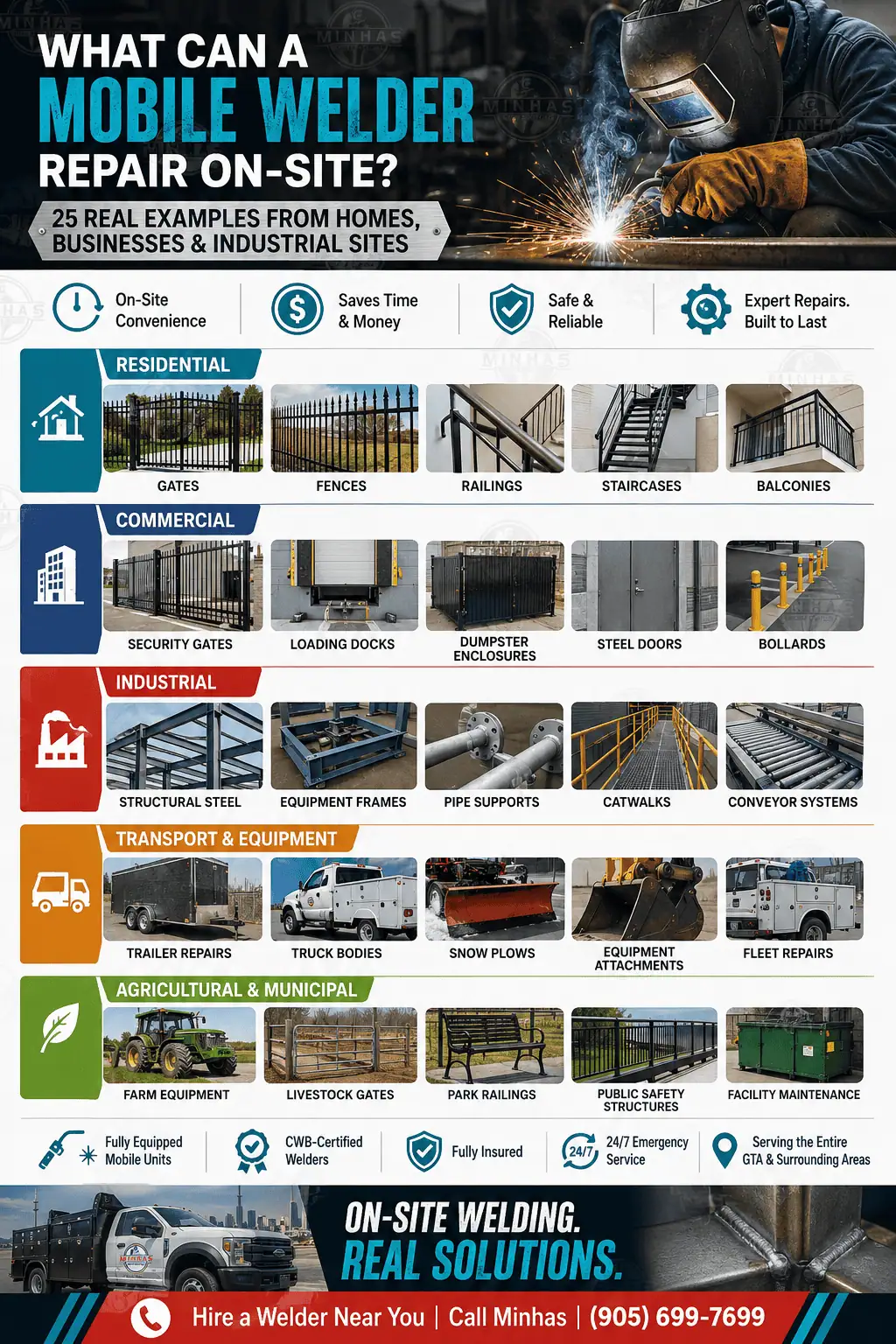
25 Real Examples of On-Site Mobile Welding Repairs
Residential Repairs
Homeowners often think welding is only for industrial projects, but residential properties throughout the GTA contain numerous steel components that can benefit from professional on-site repairs.
1. Wrought Iron Gates
Driveway gates experience constant opening, closing, wind loads, and seasonal temperature changes.
Common repairs include:
- Broken hinges
- Cracked gate frames
- Latch repairs
- Reinforcing sagging sections
- Rewelding decorative components
Because these gates are heavy and permanently installed, mobile welding is often more practical than removal.
2. Metal Fencing
Steel and wrought iron fencing can develop cracks from impact damage, corrosion, frost movement, or accidental vehicle contact.
On-site welding can restore:
- Fence posts
- Horizontal rails
- Decorative panels
- Welded joints
- Security fencing sections
Early repairs help prevent small failures from spreading throughout the fence system.
3. Handrails
Loose or broken handrails create significant safety concerns for homeowners, visitors, and tenants.
Typical repairs include:
- Detached mounting plates
- Broken welds
- Loose support brackets
- Rust-damaged connections
- Reinforcing weakened joints
Because handrails contribute to fall protection, timely repairs are essential.
4. Stair Railings
Exterior steel staircases are exposed to rain, snow, road salt, and freeze-thaw cycles throughout Ontario.
Over time, these conditions may weaken welds or accelerate corrosion.
Mobile welders can repair:
- Cracked railing joints
- Loose balusters
- Damaged support brackets
- Stair frame connections
- Protective reinforcement plates
Addressing these issues promptly helps maintain both safety and structural stability.
5. Balcony Railings
Balcony railings on homes, duplexes, and low-rise buildings endure constant exposure to moisture and seasonal weather.
Common repair needs include:
- Weld failures at corner joints
- Rust-damaged connections
- Loose posts
- Decorative iron repairs
- Reinforcement of weakened sections
In many cases, repairing the affected area on-site is more practical than removing the entire railing system.
Commercial Property Repairs
Commercial properties experience constant wear from daily operations, delivery traffic, weather, and public use. Prompt on-site repairs help property owners maintain safe facilities while minimizing disruption to tenants and customers.
6. Security Gates
Security gates are among the most frequently repaired items by mobile welders.
Whether protecting warehouses, commercial plazas, industrial yards, or condominium parking lots, these gates are exposed to repeated opening cycles, vehicle impacts, and harsh weather.
Common repairs include:
- Broken hinges
- Cracked gate frames
- Latch failures
- Track reinforcement
- Welded wheel assemblies
- Damaged support members
Repairing these components on-site often allows the gate to remain in place, eliminating the need for costly removal and reinstallation.
7. Loading Dock Components
Loading docks are critical to warehouses, manufacturing facilities, and distribution centres throughout the GTA. Even minor structural damage can interrupt shipping schedules.
Mobile welding is commonly used to repair:
- Dock bumpers
- Steel dock plates
- Safety rails
- Trailer restraint supports
- Dock edge reinforcement
- Cracked structural brackets
Fast repairs help reduce downtime while keeping loading operations running safely.
8. Dumpster Enclosures
Commercial dumpster gates and steel enclosures are frequently damaged by waste collection trucks and heavy use.
Typical repairs include:
- Broken gate frames
- Bent hinges
- Damaged latch assemblies
- Steel posts
- Reinforcement of impact-damaged corners
Because these structures are permanently installed, field repairs are usually more practical than transporting them to a fabrication shop.
9. Fire Escapes
Fire escapes must remain structurally sound to perform safely during emergencies.
Common welding repairs include:
- Stair supports
- Landing connections
- Handrails
- Guardrails
- Steel stringers
- Rust-damaged joints
Any repair involving fire escape systems should follow applicable engineering requirements and local regulations.
10. Warehouse Storage Rack Repairs
Forklift impacts are a common cause of damage to warehouse racking systems.
Mobile welding may be used to repair or reinforce:
- Rack protectors
- Steel guards
- Custom support brackets
- Protective barriers
- Equipment protection frames
Where structural rack components are severely compromised, replacement may be more appropriate than welding.
11. Steel Doors and Frames
Commercial steel doors experience years of heavy traffic.
Mobile welders frequently repair:
- Broken hinges
- Door frame cracks
- Security plates
- Threshold supports
- Damaged latch brackets
These repairs improve security while extending the service life of existing doors.
12. Parking Bollards and Safety Barriers
Parking lots, warehouses, retail plazas, and industrial facilities rely on steel bollards to protect buildings and pedestrians.
Vehicle impacts can loosen or crack welded connections.
Typical repairs include:
- Bollard reinforcement
- Base plate repairs
- Steel guard rails
- Protective barriers
- Equipment guards
Keeping these protective systems in good condition helps reduce future property damage.
Industrial Facility Repairs
Industrial facilities often operate around the clock, making equipment downtime expensive. Mobile welding allows many repairs to be completed without transporting heavy machinery.
13. Structural Steel Repairs
Steel columns, beams, support frames, and bracing occasionally require repair due to impact damage, modifications, or fatigue.
Typical work includes:
- Reinforcing steel members
- Repairing welded connections
- Installing additional gussets
- Repairing support brackets
- Strengthening structural components
Depending on the project, engineered repair procedures may be required.
14. Equipment Support Frames
Manufacturing equipment depends on rigid steel support structures.
Cracked welds can lead to:
- Excessive vibration
- Equipment misalignment
- Reduced productivity
- Safety concerns
Mobile welding helps restore these support frames while minimizing production interruptions.
15. Machine Guards
Machine guards protect employees from moving equipment.
Common repairs include:
- Broken hinges
- Cracked frames
- Protective mesh
- Safety panels
- Mounting brackets
Because these guards are essential for workplace safety, prompt repairs are often necessary.
16. Catwalks and Elevated Platforms
Industrial facilities frequently contain elevated work platforms used for maintenance and inspections.
Mobile welders commonly repair:
- Platform supports
- Guardrails
- Toe boards
- Stair connections
- Structural braces
Maintaining these structures helps improve worker safety.
17. Conveyor Systems
Conveyor equipment experiences constant movement and vibration.
Common repairs involve:
- Support frames
- Bearing brackets
- Motor mounts
- Steel legs
- Structural reinforcement
Repairing these components on-site often avoids lengthy production shutdowns.
18. Pipe Supports and Hangers
Industrial piping systems rely on properly supported steel structures.
Mobile welding may be used to repair:
- Pipe saddles
- Support brackets
- Hangers
- Anchor plates
- Structural connections
These repairs help maintain alignment while reducing stress on piping systems.
Transportation & Fleet Repairs
Fleet operators throughout Toronto and the GTA depend on reliable equipment. Mobile welding allows many repairs to be completed in company yards or job sites instead of transporting vehicles elsewhere.
19. Utility and Equipment Trailers
Trailer frames experience continuous vibration, heavy loads, and road impacts.
Typical repairs include:
- Cracked frames
- Tongue reinforcement
- Safety chain brackets
- Fender supports
- Ramp hinges
- Tailgate repairs
Repairing minor damage early can help prevent more extensive structural failures.
20. Truck Bodies and Service Vehicles
Commercial trucks frequently require welded repairs after years of daily use.
Common examples include:
- Tool box supports
- Ladder racks
- Lift gate brackets
- Equipment mounts
- Step assemblies
- Mud flap brackets
On-site repairs allow fleet vehicles to return to service more quickly.
21. Snow Plows and Salt Equipment
Ontario winters place enormous stress on snow removal equipment.
Mobile welders often repair:
- Plow frames
- Mounting brackets
- Cutting edge supports
- Salt spreader frames
- Hydraulic component brackets
Completing repairs before major snow events helps contractors avoid costly downtime.
22. Construction Equipment Attachments
Heavy equipment attachments experience constant impact and abrasion.
Common repairs include:
- Excavator buckets
- Loader buckets
- Grapple attachments
- Skid steer forks
- Quick-attach plates
- Wear plate replacement
Rebuilding worn areas can significantly extend the usable life of expensive attachments.
Agricultural Repairs
Although much of the GTA is urban, surrounding communities continue to support farming operations that rely heavily on mobile welding.
23. Farm Equipment
Agricultural equipment often operates far from repair shops.
Typical on-site repairs include:
- Cultivators
- Plows
- Harrows
- Seeders
- Feed equipment
- Steel frames
Repairing equipment in the field helps farmers return to work during critical planting and harvest periods.
24. Livestock Gates and Pens
Steel livestock handling systems experience frequent use and occasional impact damage.
Mobile welders commonly repair:
- Gate hinges
- Corral panels
- Feeding systems
- Steel posts
- Fence braces
These repairs improve both animal safety and operational efficiency.
Municipal & Public Infrastructure
Municipal facilities throughout the GTA contain thousands of welded steel components that require periodic maintenance.
25. Park and Public Safety Structures
Municipal welding repairs often include:
- Park railings
- Steel benches
- Bicycle racks
- Safety barriers
- Maintenance platforms
- Public works equipment
- Waste container enclosures
- Recreation facility steel structures
On-site repairs help municipalities maintain public spaces while reducing replacement costs.
When Is Mobile Welding Not the Right Solution?
Although mobile welding can repair a wide range of metal structures and equipment, it isn’t always the most appropriate option. A professional welder’s responsibility isn’t simply to perform a repair—it’s to determine whether a repair can be completed safely, effectively, and with long-term reliability.
In some situations, transporting the component to a fabrication shop or replacing it entirely may be the better solution.
1. Severe Corrosion Has Weakened the Metal
Surface rust is common on outdoor steel structures, especially in Ontario’s climate where moisture, road salt, and freeze-thaw cycles accelerate corrosion. While surface corrosion can often be cleaned and repaired, severe corrosion presents a different challenge.
If rust has significantly reduced the thickness of the steel, simply welding over the damaged area won’t restore its original strength. In many cases, new steel sections must be fabricated and installed instead.
Examples include:
- Steel staircases with extensive rust damage
- Balcony supports with deep corrosion
- Trailer frames weakened by years of road salt
- Equipment frames with significant material loss
A thorough inspection helps determine whether repair or replacement is the safer investment.
2. The Component Has Extensive Fatigue Cracking
Metal fatigue occurs when steel is subjected to repeated loading and unloading over many years. Unlike sudden impact damage, fatigue develops gradually and often produces multiple cracks around welded joints.
Common examples include:
- Trailer frames
- Heavy equipment attachments
- Crane supports
- Manufacturing equipment
- Conveyor systems
If fatigue cracking is widespread, repairing one crack may not prevent additional failures nearby. In these situations, replacing the affected section can provide a more durable long-term solution.
3. The Damage Affects Critical Structural Integrity
Some structural components support significant loads or are part of engineered building systems.
These may include:
- Building columns
- Structural beams
- Mezzanines
- Pipe racks
- Equipment platforms
- Crane runway beams
Depending on the extent of the damage, repairs may require engineering approval, specialized welding procedures, or inspections before the structure is returned to service.
4. Specialized Shop Equipment Is Required
Certain fabrication projects simply cannot be completed in the field.
Examples include:
- CNC machining
- Large-scale custom fabrication
- Heat treatment
- Precision alignment
- Robotic welding
- Powder coating after fabrication
In these cases, a fabrication shop provides better control over the manufacturing process.
5. Safety Conditions Prevent On-Site Welding
Safety always takes priority.
A mobile welder may postpone or relocate work if conditions present unacceptable risks, such as:
- Active fuel leaks
- Explosive atmospheres
- Inadequate ventilation
- Unsafe access
- Electrical hazards
- Confined spaces without proper permits
- Severe weather conditions
Completing repairs safely protects workers, property, and the surrounding environment.
Common Metals That Can Be Repaired On-Site
One of the advantages of professional mobile welding is the ability to work with a variety of metals commonly found in residential, commercial, and industrial environments.
Carbon Steel
Carbon steel is the most frequently repaired material.
Applications include:
- Structural steel
- Gates
- Railings
- Trailers
- Equipment frames
- Pipe supports
- Machinery
Because of its strength and weldability, carbon steel is suitable for many on-site repairs.
Structural Steel
Structural steel forms the backbone of commercial buildings, warehouses, industrial facilities, and construction projects.
Typical repairs include:
- Beam connections
- Brackets
- Columns
- Base plates
- Reinforcement plates
- Steel framing
Repairs may require engineered procedures depending on the application.
Stainless Steel
Stainless steel is widely used where corrosion resistance and hygiene are important.
Examples include:
- Commercial kitchens
- Food processing facilities
- Pharmaceutical plants
- Breweries
- Medical facilities
Proper welding techniques help maintain corrosion resistance and appearance.
Aluminum
Aluminum is lightweight, corrosion-resistant, and commonly found in:
- Trailer bodies
- Truck components
- Marine equipment
- Loading ramps
- Access platforms
Because aluminum behaves differently than steel during welding, proper equipment and expertise are essential.
Cast Iron
Cast iron repairs can sometimes be completed on-site, but they require specialized procedures.
Applications may include:
- Equipment housings
- Pumps
- Machinery bases
- Certain agricultural components
Depending on the extent of the damage, replacement may be more economical.
Galvanized Steel
Galvanized steel is commonly used for outdoor structures because of its protective zinc coating.
Examples include:
- Fencing
- Utility structures
- Sign posts
- Guardrails
Special preparation and ventilation are required when welding galvanized materials.
What Happens During a Mobile Welding Service Call?
Many first-time customers aren’t sure what to expect when hiring a mobile welder. While every project is unique, the repair process typically follows several key steps.
Step 1: Initial Consultation
The process usually begins with a phone call or online inquiry.
Helpful information includes:
- Photos of the damage
- Location
- Material type
- Dimensions
- Accessibility
- Urgency
Providing clear photos often allows the welder to arrive with the appropriate equipment and consumables.
Step 2: Site Assessment
Upon arrival, the welder evaluates:
- The extent of the damage
- Structural condition
- Safety hazards
- Material thickness
- Weld accessibility
- Repair options
If the repair is unsuitable for field welding, alternative recommendations may be provided.
Step 3: Site Preparation
Proper preparation is one of the most important steps in achieving a durable weld.
Preparation may involve:
- Removing rust
- Grinding damaged welds
- Cleaning contaminants
- Aligning components
- Installing temporary supports
- Protecting nearby surfaces
Good preparation contributes significantly to weld quality.
Step 4: Welding and Repair
The appropriate welding process is selected based on the material, thickness, environment, and repair requirements.
During this stage, the welder may:
- Remove failed welds
- Install reinforcement plates
- Replace damaged brackets
- Restore cracked joints
- Build up worn surfaces
Step 5: Inspection
After welding, the repair is visually inspected to verify:
- Weld quality
- Proper fusion
- Alignment
- Structural integrity
- Overall workmanship
Additional finishing may be completed where required.
Step 6: Site Cleanup
Professional mobile welding includes cleaning the work area by removing grinding debris, scrap metal, and consumables whenever practical, leaving the site in a safe condition.
What Factors Affect Mobile Welding Costs?
Every repair is different, which is why most mobile welding companies provide customized estimates rather than fixed pricing.
Several factors influence the overall cost.
Type of Repair
A small gate hinge repair differs significantly from reinforcing structural steel or repairing industrial equipment.
Material
Different materials require different welding procedures, filler metals, shielding gases, and preparation techniques.
Accessibility
Repairs performed at height, in confined spaces, or in difficult-to-access locations typically require additional setup time.
Repair Complexity
Simple crack repairs generally take less time than rebuilding damaged components or fabricating replacement parts.
Travel Distance
Travel within the GTA varies depending on location, traffic conditions, and response requirements.
Emergency Response
After-hours, weekend, and emergency service calls often involve different scheduling considerations than planned maintenance.
Equipment Requirements
Some projects require engine-driven welders, generators, lifting equipment, plasma cutting, or specialized welding processes.
Engineering or Inspection Requirements
Structural projects may require documentation, inspections, or coordination with engineers before repairs are completed.
Industries Throughout the GTA That Rely on Mobile Welding
Mobile welding supports a diverse range of industries across the Greater Toronto Area.
Construction
Contractors depend on on-site welding for structural steel modifications, equipment repairs, temporary supports, and installation work.
Property Management
Commercial property managers frequently require repairs to gates, railings, staircases, loading docks, and security barriers.
Manufacturing
Manufacturing facilities rely on mobile welding to reduce production downtime by repairing equipment directly on-site.
Warehousing and Logistics
Distribution centres use mobile welding for dock equipment, racking protection, trailers, and material handling systems.
Transportation
Fleet operators require timely repairs to trailers, truck bodies, equipment racks, and snow removal equipment.
Municipal Infrastructure
Cities and municipalities maintain parks, maintenance facilities, public works equipment, and safety barriers through scheduled welding repairs.
Agriculture
Farm operators benefit from field repairs that reduce equipment transportation during busy planting and harvesting seasons.
Preventative Maintenance Tips to Extend the Life of Welded Structures
Many emergency repairs can be avoided through routine inspections and maintenance.
Consider these best practices:
- Inspect welded joints regularly for visible cracks.
- Address small failures before they spread.
- Remove dirt and road salt from steel components.
- Repair damaged protective coatings promptly.
- Avoid exceeding equipment load ratings.
- Tighten loose fasteners that may increase vibration.
- Schedule inspections for heavily used trailers and equipment.
- Investigate unusual movement or noises from steel structures.
Preventative maintenance is often more cost-effective than emergency repairs or full component replacement.
Need reliable welding work without the hassle of transporting heavy equipment or materials? Hire a professional mobile welder near you for on-site repairs, custom fabrication, structural welding, and more. Get expert workmanship where you need it and request your free quote today.
