


If you’ve ever quietly wondered whether you’re “doing grief wrong” — moving too fast, too slow, feeling angry when you thought you’d feel sad, or feeling strangely okay when you thought you’d be devastated — you’re not alone, and you’re not broken. That worry usually traces back to one specific idea: the five stages of grief.
Grief counsellors hear it constantly. Therapists who work in grief counselling in Mississauga often say it’s one of the most common sources of unnecessary guilt people carry into their first session after a loss — the fear that something is wrong with them because their grief doesn’t match the tidy five-step chart they’ve absorbed from movies, books, and half-remembered psychology classes. Denial, anger, bargaining, depression, acceptance: it’s one of the most widely known psychological ideas in pop culture.
There’s just one problem. It was never designed to describe how people grieve a loss, and decades of research on actual bereaved people have found that grief rarely moves through it in order — or at all. Here’s what the five-stage model actually was, what grief research has found instead, and what genuinely helps when you’re the one grieving.
What Are the Five Stages of Grief?
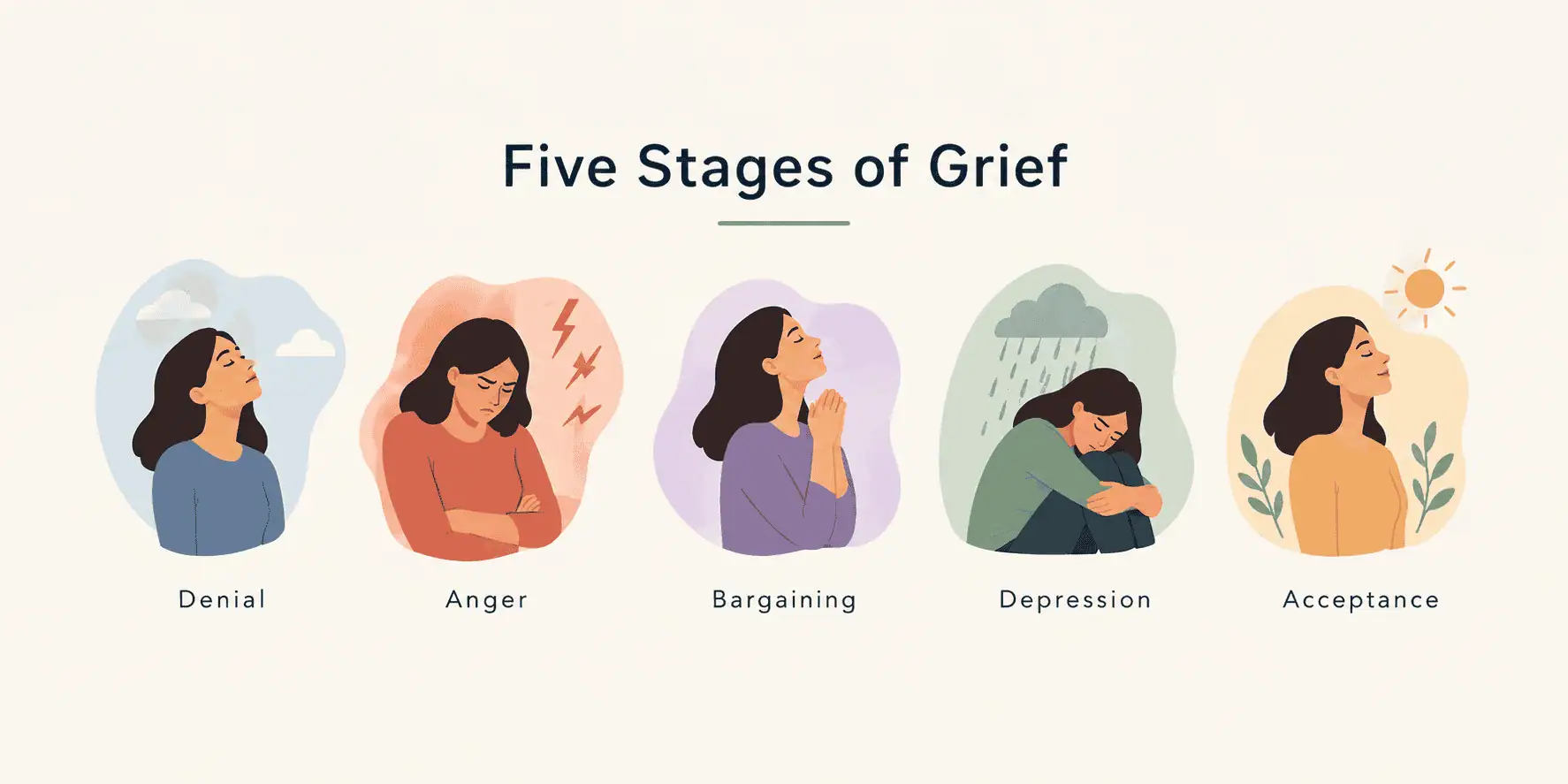
The Five Stages of Grief are a commonly used framework developed by psychiatrist Elisabeth Kübler-Ross to describe emotional responses people may experience after a significant loss:
- Denial — Feeling shocked, numb, or unable to accept what has happened.
- Anger — Experiencing frustration, resentment, or feelings of unfairness.
- Bargaining — Thinking about “what if” scenarios or wishing things could have happened differently.
- Depression — Feeling deep sadness, loneliness, emptiness, or withdrawal.
- Acceptance — Gradually acknowledging the reality of the loss and beginning to adjust to life afterward.
Importantly, grief doesn’t necessarily follow these stages in order. Someone may experience only some of them, move back and forth between them, or experience several emotions at once.
Where Did the 5 Stages of Grief Come From?
The five stages trace back to psychiatrist Elisabeth Kübler-Ross’s 1969 book On Death and Dying. Her research wasn’t about people grieving a loss at all — it was based on interviews with terminally ill patients coming to terms with their own approaching death. Denial, anger, bargaining, depression, and acceptance described emotional territory that dying patients moved through, not the emotional territory of the people left behind.
The model was only extended to bereavement later, largely through popular interpretation rather than new research on grieving people themselves, a distinction later researchers have gone on to document in detail.
Even Kübler-Ross eventually pushed back on how rigidly her work had been applied. In her later writing, she clarified that the stages were never meant to be a fixed timeline, and that most people don’t move through them in order — or experience all of them at all.
What Does Grief Research Actually Tell Us?
Since then, researchers have studied bereaved people directly, rather than dying patients, and the picture that’s emerged looks nothing like a five-step staircase. Some of the most influential work in this space comes from Columbia University psychologist George Bonanno, who has spent decades tracking how people actually respond to major losses. In a landmark study following bereaved spouses, Bonanno found that the most common response wasn’t a slow climb through stages toward acceptance — it was resilience.
Roughly 46% of participants showed what he termed a “stable low distress” pattern: real, genuine grief, without a prolonged breakdown in day-to-day functioning. Around 16% showed a gradual recovery pattern, and about 11% experienced more chronic, prolonged grief.
Smaller groups showed other patterns entirely. In other words, there isn’t one “normal” way to grieve. There are several, and none of them is a straight line.
Ask any clinician who actually sits with grieving people for a living and you’ll hear a version of the same thing: real grief behaves less like a staircase and more like weather, clear for a stretch, then a sudden storm, sometimes years apart, with no schedule to check it against.
What Actually Shapes How Grief Unfolds
If it’s not a fixed sequence of stages, what does shape someone’s grief? Research points to several factors that matter far more than “time since the loss”:
- How the loss happened. A sudden or traumatic death tends to produce a different grief trajectory than an anticipated death after a long illness.
- The relationship to the person who died. Losing a spouse, a child, a parent, or a friend each carries distinct grief patterns.
- Prior mental health and life stress. Existing anxiety, depression, or unresolved past losses can intensify or complicate current grief.
- Social and cultural support. Grief that’s witnessed, spoken about, and supported by community tends to move differently than grief carried in isolation.
- Personality and coping style. Some people process loss by talking it through; others process it by returning to routine and structure. Neither is more “correct” than the other.
None of these are stages. They’re context, and they explain why comparing your grief to someone else’s, or to a chart, rarely tells you anything useful about your own.
When Grief Becomes Something More
Most grief, however painful, eases with time on its own. But a meaningful minority of people develop a more persistent, disabling form of grief that doesn’t resolve the way typical grief does — and as of 2022, it’s a recognized clinical diagnosis.
The American Psychiatric Association added Prolonged Grief Disorder to the DSM-5-TR, the manual clinicians use to diagnose mental health conditions. It’s defined by an intense, persistent grief response — present most days, for at least a month — that continues at least 12 months after the loss (6 months for children and teens) and significantly interferes with daily functioning.
Signs can include an ongoing sense that part of yourself has died along with the person, difficulty re-engaging with life or relationships, and avoidance of anything that’s a reminder of the loss. The distinction matters because it’s not really about how much someone grieves, or for how long in an absolute sense — plenty of people carry grief meaningfully for years without it becoming disabling.
It’s about whether grief has become stuck in a way that’s actively preventing someone from functioning, well past the point where most people’s symptoms have started to ease. If that sounds familiar, it’s worth talking to a professional rather than waiting to see if it passes on its own.
Better Ways to Think About Grief Than “Stages”
Grief researchers have proposed several models that fit the evidence better than a fixed sequence. One of the most widely used is the Dual Process Model, developed by researchers Margaret Stroebe and Henk Schut.
Instead of stages, it describes an oscillation: people move back and forth between “loss-oriented” coping — actively grieving, remembering, feeling the pain — and “restoration-oriented” coping — returning to daily tasks, work, and life.
Healthy grieving isn’t picking one and finishing it before moving to the next. It’s swinging between both, sometimes within the same day. Another useful framework comes from grief researcher J. William Worden, who described grief as a set of tasks rather than stages: accepting the reality of the loss, processing the pain of it, adjusting to a world without the person, and finding a way to carry the relationship forward while still moving through life.
Tasks, unlike stages, can be revisited in any order, at any pace, more than once — which tends to match people’s lived experience far better than a checklist ever did.
What Actually Helps
If “wait for the stages to pass” isn’t useful advice, what is? A few things consistently show up across grief research and clinical practice:
- Talk about the person, not just the loss. Naming memories and continuing to reference the person you lost — rather than avoiding the subject to protect others’ comfort — tends to support healthier long-term adjustment.
- Don’t force a timeline. There’s no evidence-based deadline for grief. Comparing your pace to a chart, or to how quickly someone else seemed to “move on,” usually just adds guilt on top of grief.
- Let grief and normal life coexist. Going back to work, laughing at something, or having a genuinely good day doesn’t mean you’ve stopped grieving. It’s usually a sign of the healthy oscillation researchers describe, not a betrayal of the person you lost.
- Build in ritual. Anniversaries, small routines, or intentional ways of marking the loss give grief a place to go, rather than leaving it to surface unpredictably.
- Watch for isolation, not sadness. Sadness is a normal, expected part of grief. Pulling away from every relationship and routine for months on end is more often a sign that support is needed.
- Get support if it’s not easing. If grief still feels unmanageable well past a year, or it’s stopping you from functioning, that’s not a personal failing — it’s a sign to talk to a therapist or grief counsellor, the same way you would for any other condition that isn’t resolving on its own.
The Bottom Line
Grief was never meant to fit on a five-step chart. It’s shaped by who you lost, how you lost them, and who you are — and it moves in its own order, on its own timeline, sometimes for years. Letting go of the idea that you’re supposed to be “further along” by now is often the first real step toward actually feeling better.
If grief has brought you to a point where you’re having thoughts of not wanting to go on, please reach out — call or text 9-8-8, Canada’s Suicide Crisis Helpline, anytime, day or night.
Frequently Asked Questions
Are the five stages of grief real?
They describe some emotions many people experience during loss, but not as a fixed, universal sequence. They were originally developed to describe dying patients coming to terms with their own death, not survivors grieving a loss — and research on bereaved people has found grief to be far more individual and non-linear than the stage model suggests.
How long is grief supposed to last?
There’s no fixed timeline. Grief trajectories vary widely between people, and continuing to feel grief — even years later, especially around anniversaries — is common and doesn’t by itself indicate a problem.
What’s the difference between grief and prolonged grief disorder?
Ordinary grief, even when intense, tends to ease over time without stopping someone from functioning. Prolonged grief disorder is a recognized clinical diagnosis involving persistent, disabling grief symptoms that continue at least 12 months after a loss and significantly interfere with daily life.
Is it normal to feel fine one day and devastated the next?
Yes — this is closer to how grief actually works than any linear model. Researchers describe this oscillation between engaging with the loss and engaging with daily life as a healthy part of adjusting, not a sign that something is wrong.
When should someone seek professional help for grief?
If grief is preventing daily functioning well beyond the first year, or simply isn’t easing despite time and support, it’s reasonable to speak with a therapist or grief counsellor rather than assuming it will resolve alone.
