


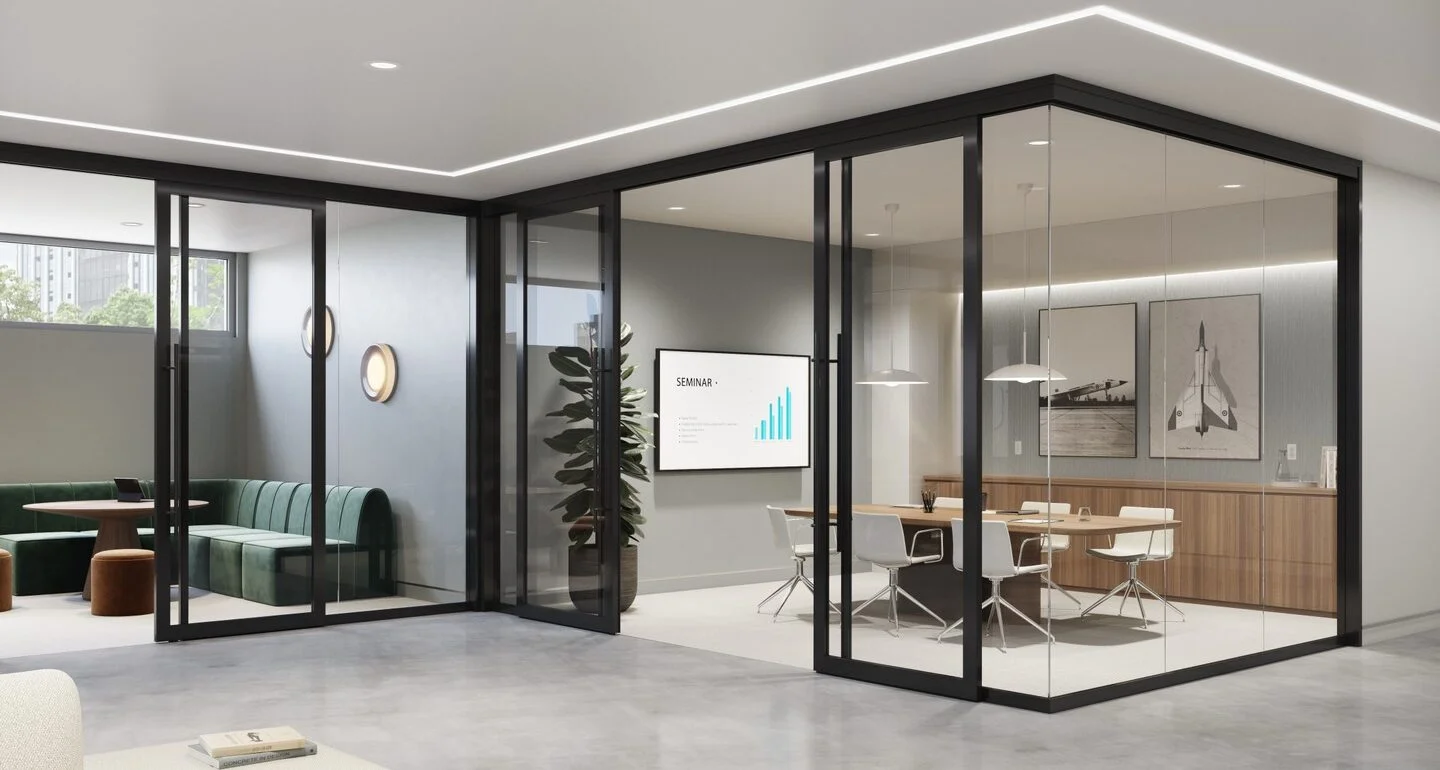
Modern office design is increasingly focused on flexibility, aesthetics, and functionality. As companies strive to create workspaces that are both efficient and visually appealing, door systems play a critical role in shaping the office environment. Sliding doors and barn doors have emerged as popular solutions, offering versatility, space optimization, and design appeal that traditional hinged doors often cannot provide.
Whether used to divide meeting rooms, create private office areas, or define collaborative zones, these door systems can enhance workflow, improve space utilization, and elevate the overall office experience.
The Rise of Sliding and Barn Doors in Office Design
The chief problem that traditional hinged doors bring, concerning human-made living spaces, is that they consume a lot of space, leaving not much for furniture and interior design work. Thanks to the track beneath which the sliding and barn doors glide, the clearance does not become an issue.
Useful for office setups:
- Maximize the usable space
- Possess a cool appearance
- Permit flexibility for zone areas and privacy boundaries
- Allow effortless user movement and access
The resulting combination of utility and style behind sliding and barn doors has made these immensely desirable solutions for commercial interior projects everywhere, right from design studios to corporate headquarters.
Understanding sliding doors
Sliding doors have panels inserted to move side by side through a track, either in a small concealed cavity in the wall or, externally, clinging onto a track. It’s produced with clear glass, timber, metal, or any form of material possible for builders and designers to put into a facility-wide theme.
Benefits of Sliding Doors in the Office
- Sleek, Self-Supporting Design: Maintains clear sightlines for a clean, modern aesthetic.
- Flexible Installation: Easily mounts to drywall or drop ceilings.
- Optimized for Glass Wall Systems: Ideal for single-glazed sidelites, adding a polished finish.
- Customizable Options: Available in full-height or transom configurations to match your design needs.
They are excellent for propagating natural light deep into the interiors, confirmation of light and dietary openness as the main decoration.
Sliding doors boast acoustic integrity, and these dividers can be combined into floor-to-ceiling glass partitions, giving an aesthetic appearance, translucent glass fronts, and soundproofing qualities wherever glass is preferred and pleasingly accentuated at the yearly scale.
Sliding doors are quite versatile in their applications. They can be employed in quite open-plan offices, conference rooms, or wherever space needs temporary or flexible division.
Advantages of Barn Doors in Offices
- Architectural: They offer character and design appeal
- Fashion and Function: They save up space by eliminating the space needed for swinging.
- Customization: They come in a range of materials, colors, and hardware.
- Easy Setup: Most of them can be fitted into existing walls.
Barn doors are furniture pieces mixing both fashion and function, crafted in a design of collaborative work areas, executive workspaces, and other more creative areas.
Finish and Material Options
In order to suit the office interior, both sliding doors and barn doors can be customized. The materials commonly include:
- Glass: Allows for transparency, flows natural light, and provides contemporary elegance.
- Wood: Warm and textural, perfect for high-end and traditional office settings.
- Metal: Created in accordance with the industrial or minimalist design outlook, metal really stands the test of time, being extremely strong.
- Mixed Materials: The way to go while wanting glass and steel beside wood to give the room an iconic and functional face.
Material choice is fundamentally directed by aesthetic considerations as well as by points like durability and maintenance.
Sustainability Considerations
The necessity and urge for more sustainable office designs grow every day. Sliding and barn doors are playing a part in endorsing environmental values through the following:
- Using materials that are tough and have a durable service life
- Lesser wall construction
- Boosting modularity practices and one-touch reconfiguring to minimize waste of materials
- Enabling natural light and thus deterring the over-dependence on artificial lighting
In the quest for furthering the eco-qualification of their project, the office could pick not only sustainably sourced wood but also recyclable metals or even low-VOC glass.
Choosing the Best Between Sliding and Barn Doors
The choice of a sliding or barn door will depend on one’s office use:
- Sliding doors work best in any area where transparency and the daylight flow function seamlessly within contemporary layouts.
- Barn doors are always for statement and executive zones, places with visually stunning but substantial doors.
Often, the combination of both systems is the case for an office; such an exotic juxtaposition results in a balance of function and flair.
Budget/Operational Considerations
In initial cost terms, the costs could fluctuate depending on material and door hardware selections, door mounting details, etc. However, door solutions reduce maintenance vs. the hinged doors, and the reconfigurable nature of these door solutions appeals for the minimization of the rest of the cost in the case that the mounting of the doors ever has to tremble. Lastly, the doors are durable and stand the test of time.
To enable, support, and facilitate another third party’s undertaking in dynamics today (present day) and into the faraway future, a life-cycle perspective will usually bring appreciably lower financial burden and increased effectiveness, with the cumulative result exceeding multiplying over the period of its long, long life.
Conclusion
Sliding and barn doors are reshaping the concept of modern office interiors due to the flexibility, aesthetic appeal, and functional advantage that traditional doors simply cannot offer. They maximize space and allow for private working areas and collaboration zones while adding to spatial design.
By choosing the right door system, offices can ensure that style and efficiency are combined without sacrificing practicality, hence creating a workspace that is adaptable, sustainable, and aesthetically engrossing.
Frequently Asked Questions
What is the difference between sliding and barn doors?
Architects often set sliding doors into a recess or mount them on a track. They can also construct them partially or entirely from glass to allow greater light flow. In contrast, barn doors slide the long length of a wall outside, usually serving as decorative pieces.
Are sliding and barn doors suitable for all office types?
Absolutely. These two options provide a very versatile solution for open spaces, enclosed rooms, meeting tables, or informal gathering areas to suit any modern or traditional design aesthetics.
Is the spatial role of such doors highlighted?
Absolutely, sliding and barn doors remove the need for swing clearance, and they permit furniture to march into the walls within. Most desks and floors will be utilized because no hinge movement or swing is required.
In which way can office soundproofing be done with sliding and barn doors?
For sliding doors with a high-end, fancier appearance, double glazing might work best for soundproofing, or you would otherwise need seals. Otherwise, plain, solid barn doors are better sound insulators.
Is it appropriate to use sliding and barn doors in the long run in an office?
Yes. These designs have ended up being long-lasting, low-maintenance, and also reusable, thus significantly reducing material wastage and supporting sustainable practices in interior design.
