


The Data Crisis No One Is Talking About
Every two years, humanity creates roughly as much data as in all of recorded history combined. By 2025, the global datasphere surpassed 180 zettabytes. Yet the media we use to store it — magnetic hard drives, tape cartridges, optical discs — degrades quietly and inevitably. A standard hard drive has a realistic lifespan of three to five years under load. Enterprise magnetic tape, long considered the gold standard for cold archival storage, needs to be replaced every five to seven years. A Roman stone inscription carved 2,000 years ago is still legible today. A DVD pressed in 2005 may already be failing. This is the paradox Microsoft’s Project Silica was built to solve: how do you preserve digital information not just for decades, but for civilizations?
The answer, published in a landmark Nature paper in February 2026, is surprisingly familiar. It starts with a material found in every kitchen cabinet — borosilicate glass, the same compound in most Pyrex products — and ends with a storage medium validated to last more than 10,000 years.
What Is Project Silica?
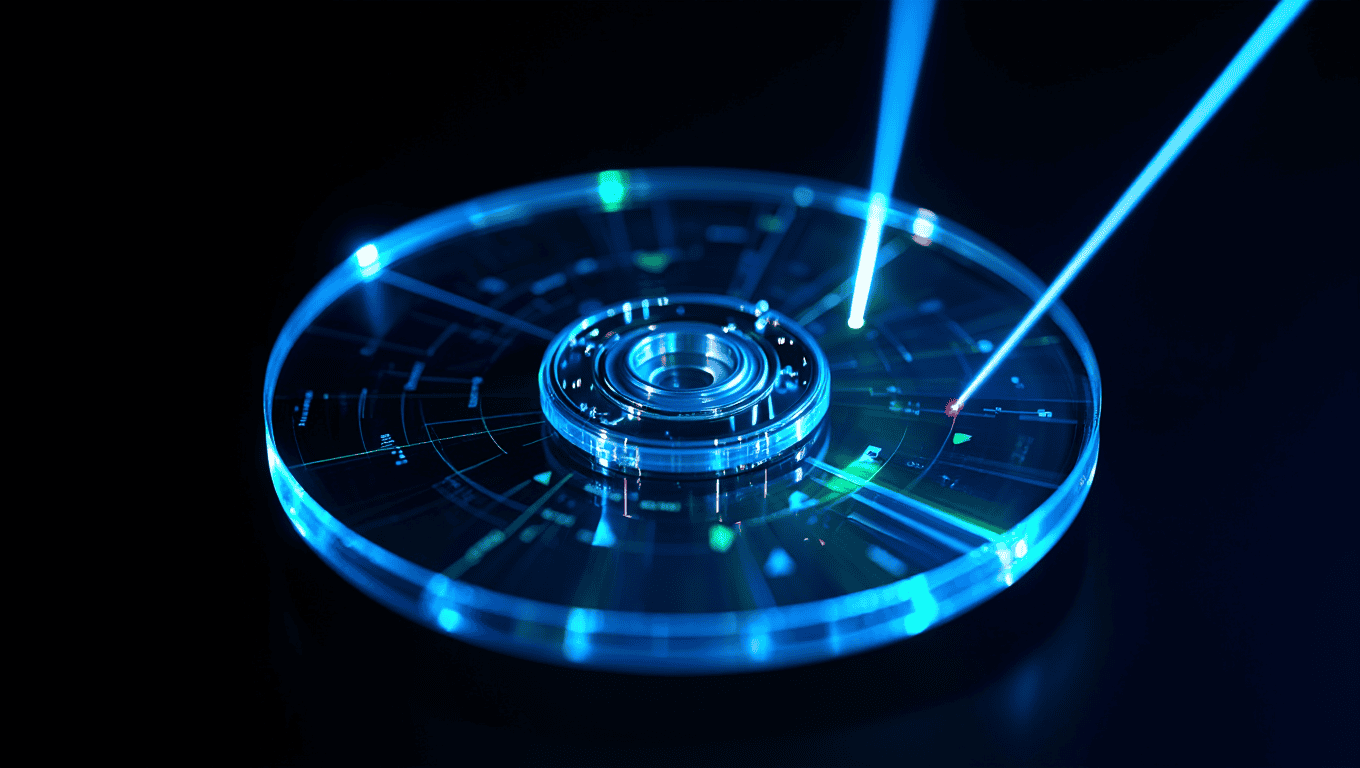
A coaster-size glass plate. No power. No degradation. Project Silica is building sustainable glass storage that preserves the world’s data for 10,000 years.
The result is a passive, write-once storage medium that requires zero energy to maintain once written. No cooling. No mechanical parts. No periodic migration. A glass plate written today could be placed on a shelf and retrieved — perfectly intact — long after any existing data center has turned to dust.
Microsoft has already moved the technology beyond the research phase. Project Silica is now being used internally within Azure to store critical archival data, and real-world proofs of concept include encoding Warner Bros.’ original 1978 Superman film onto a single glass plate, partnering with the Global Music Vault to archive music beneath Arctic ice, and contributing to a student-led “Golden Record 2.0” initiative. Similar technology was already shown on old movies.
The Project Silica Physics: How Data Store into Glass
Understanding Project Silica requires a brief foray into optics. A femtosecond laser fires pulses of light lasting just quadrillionths of a second — so brief that they deposit energy into a microscopic point inside the glass before heat can spread to surrounding material. This pinpoint energy creates a voxel: a three-dimensional pixel, roughly 0.5 micrometers across, embedded within the glass at a specific depth and location.
Unlike a traditional hard drive that magnetizes a surface, or a DVD that burns pits into a reflective coating, Project Silica writes throughout the entire volume of the glass. A single 2mm-thick plate — roughly the footprint of a drink coaster — can accommodate hundreds of stacked layers of voxels.
The latest system demonstrated 301 layers in a 120mm square piece of glass, yielding more than 2 terabytes of stored data. In fused silica configurations, capacity reaches 4.84 terabytes — the equivalent of approximately 2 million printed books or 5,000 ultra-high-definition 4K films.
Data is read back using an automated wide-field microscope that shines polarized light through the glass and captures how each voxel interacts with that light. Machine learning models then decode the optical signatures, compensating for noise and inter-voxel interference, and forward error correction ensures complete data recovery even with minor imperfections in the glass.
The Pyrex Breakthrough: Why Borosilicate Changes Everything
The most significant advance in the February 2026 Nature paper is not raw storage density. It is the shift in materials.
Until now, Project Silica worked exclusively with fused silica — an extremely pure, expensive form of glass available from only a handful of specialized manufacturers worldwide. This made the technology impressive as a research demonstration but impractical for commercial deployment at scale.
The new research unlocked the ability to use borosilicate glass instead. Made from a combination of silica and boron trioxide, borosilicate glass is thermally stable, chemically resistant, and manufactured in enormous quantities. It is the material in laboratory Erlenmeyer flasks, telescope mirror blanks, and, critically, the baking dishes and stovetop cookware sold under the Pyrex brand in kitchens around the world. It is also dramatically cheaper and more widely available than fused silica.
To make borosilicate work, Microsoft’s team invented a new category of voxel: the phase voxel. Rather than altering how the glass interacts with polarized light (the mechanism used in the older birefringent voxel approach), phase voxels modify the refractive index of the glass — how fast light travels through a specific point. This change requires only a single laser pulse per voxel, compared to the multi-step process previously needed, significantly reducing writing complexity and energy requirements.
The trade-off is density: phase voxels in borosilicate currently store less data per plate than birefringent voxels in fused silica. But the manufacturing simplicity, broader material availability, and simplified reading hardware (one camera instead of three or four) make borosilicate a more viable path toward commercial-scale deployment.
Microsoft’s researchers have not yet committed to one voxel type for production systems. The team frames birefringent voxels as the high-performance option and phase voxels as the scalable, accessible option — and both remain active development tracks.
Project Silica Durability: Tested Against Time Itself
The 10,000-year durability claim is not marketing. It is the product of rigorous accelerated aging methodology rooted in materials science. Because no technology company can wait millennia to test a product, Microsoft’s researchers subjected written glass samples to extreme thermal stress — repeatedly heating plates to temperatures as high as 554°F (290°C). At these temperatures, molecular diffusion and structural relaxation that would normally take thousands of years at room temperature occur within hours. The voxels remained stable and fully recoverable throughout. At ambient room temperatures, the data is projected to outlast not just current storage technologies, but most of recorded human civilization. Glass is also naturally resistant to the hazards that destroy conventional storage: water, humidity, electromagnetic pulses, radiation, most chemicals, and physical scratching. The one vulnerability that engineers openly acknowledge? Mechanical fracture. Don’t drop it.Parallel Writing and the Road to Industrial Scale
One of the remaining engineering challenges has been write speed. Early Project Silica demonstrations wrote data at under 1 Megabit per second — far too slow for practical data center intake. The new research addressed this with multi-beam parallel writing, in which a single laser source is split into multiple simultaneous beams, each encoding different voxels at the same time. Combined with a mathematical model that accounts for pre-heating and post-heating effects within the glass (which previously limited how close adjacent voxels could be placed), the system achieved write speeds of 18.4 Megabits per second for phase voxels, with theoretical maximums of up to 25.6 Megabits per second using single-beam approaches at full laser repetition rate. This is still orders of magnitude slower than a conventional SSD. But for archival cold storage — data written once and accessed rarely — throughput requirements are entirely different. What matters is not speed at the moment of writing, but cost, durability, and energy efficiency over the storage lifetime. On all three, glass is transformative.The Sustainability Argument
The environmental case for glass archival storage is compelling. Today’s enterprise data centers dedicate enormous energy resources to maintaining archival storage: cooling tape libraries, powering mechanical systems, and managing the logistics of data migration every five to seven years as media reaches end of life. Each migration cycle introduces failure risk and consumes additional energy. A glass plate that sits passively on a shelf for 10,000 years eliminates all of that. No power draw. No cooling overhead. No migration cycles. For the portion of the data economy dedicated to true long-term archival — medical records, legal documents, cultural preservation, scientific datasets, government archives — glass storage could dramatically reduce both the carbon footprint and operational cost of data preservation. Borosilicate glass is also made from abundant raw materials, is fully recyclable, and produces no hazardous waste at end of life.Real-World Deployments: Superman, the Arctic, and Azure
Project Silica’s proofs of concept span from Hollywood to the Arctic Circle. The team’s most cited demonstration is the encoding of Warner Bros.’ original Superman (1978) onto a single glass plate, demonstrating that a full feature film — and its metadata — can be reliably written and retrieved. The project also partnered with the Global Music Vault, a cultural preservation initiative that stores music in a mountain vault on Svalbard, Norway, where glass media is now included alongside the physical recordings. Perhaps most significantly for commercial viability, Microsoft confirmed that Project Silica is now deployed inside Azure’s production infrastructure, where it is being used for internal archival storage. This moves the technology from research curiosity to operational reality, providing real-world validation of the reading, writing, and retrieval pipeline at scale.What Comes Next
The Project Silica team has identified a clear scaling roadmap. Increasing the numerical aperture of the write objective from 0.6 to 0.85 could reduce voxel volume by roughly four times and cut write energy requirements significantly. Higher-performance glass compositions with lower laser modification thresholds are being evaluated. Commercially available laser systems operating at 50 MHz repetition rates — compared to 10 MHz in the current research system — could multiply write speeds fivefold. The central open question remains the birefringent-versus-phase voxel decision for production systems. That choice will determine whether the scaled technology prioritizes density (fused silica, birefringent voxels) or accessibility and simplicity (borosilicate, phase voxels). Microsoft has not publicly committed either way.Bottom Line
Project Silica represents one of the most consequential advances in data storage since the magnetic hard drive. By encoding information as three-dimensional voxels inside glass using femtosecond lasers, and by extending that capability to widely available borosilicate glass, Microsoft has demonstrated a credible path toward archival storage that is not measured in decades but in millennia. The technology will not replace SSDs for everyday computing. It will not appear in consumer laptops. But for the growing volume of information that humanity is obligated — legally, ethically, or culturally — to preserve for future generations, glass storage offers something no existing medium can match: a genuinely permanent record. The irony is difficult to ignore. The material that might ultimately safeguard the digital legacy of our civilization is the same one that has been sitting in kitchen cabinets, absorbing dinner leftovers, for decades. It just needed Microsoft, a femtosecond laser, and a decade of research to unlock its true potential. Sources: Microsoft Research Project Silica; Nature (February 2026); IEEE Spectrum; New Atlas; Gizmodo; Blocks & Files; Webpronews Lorem ipsum dolor sit amet, consectetur adipiscing elit. Ut elit tellus, luctus nec ullamcorper mattis, pulvinar dapibus leo.FAQ: Microsoft Project Silica Glass Storage
What is Microsoft Project Silica?
Microsoft Project Silica is a research and storage initiative that uses femtosecond laser pulses to encode data as three-dimensional voxels inside glass plates. Unlike conventional hard drives or magnetic tape, the data is embedded through the full volume of the glass, requires zero energy to maintain once written, and is designed to last more than 10,000 years without degradation.
How much data can a Project Silica glass plate store?
A single glass plate — roughly the size of a drink coaster — can currently store up to 4.84 terabytes of data using fused silica and birefringent voxels, equivalent to approximately 2 million printed books or 5,000 ultra-high-definition 4K films. Borosilicate glass plates using the newer phase voxel method currently store less per plate but are cheaper to produce and easier to scale.
Why is borosilicate glass — the same material as Pyrex — significant for this technology?
Until 2026, Project Silica relied exclusively on expensive, specialist-grade fused silica glass. The breakthrough published in Nature in February 2026 demonstrated that borosilicate glass — a widely manufactured, far more affordable material used in laboratory equipment and kitchen cookware like Pyrex — could also store data reliably using a new type of laser-written voxel called a phase voxel. This dramatically lowers the material cost barrier and makes large-scale commercial deployment significantly more feasible.
How durable is glass storage compared to hard drives and magnetic tape?
Standard hard drives last 3–5 years under load. Enterprise magnetic tape needs replacing every 5–7 years. Project Silica glass plates have been validated through accelerated thermal aging tests — heated to 290°C repeatedly — to remain fully readable, with data integrity projected to hold for over 10,000 years at room temperature. Glass is also naturally resistant to water, humidity, electromagnetic pulses, radiation, and most chemicals.
Is Project Silica glass storage available to the public?
Not yet for consumers. As of early 2026, Project Silica is deployed internally within Microsoft Azure’s production infrastructure for archival cold storage, making it an operational enterprise technology rather than a public product. Microsoft has not announced a commercial release date or a consumer-facing product. Access remains limited to Microsoft’s own systems and select research and cultural preservation partnerships, such as the Global Music Vault in Svalbard, Norway.
When could glass storage become available more broadly — and what would it cost?
Microsoft has not published a public commercial roadmap or pricing for Project Silica. However, the shift to borosilicate glass is widely interpreted by analysts as a deliberate step toward cost-effective scaling. Industry observers expect enterprise-tier glass archival storage products — aimed at government archives, media companies, healthcare systems, and research institutions — to emerge within the next 5 to 10 years, likely priced competitively against high-end tape libraries for long-duration cold storage workloads. Consumer availability, if it comes at all, would follow considerably later.
What are the limitations of Project Silica glass storage?
Glass storage is a write-once medium — data cannot be erased or overwritten once encoded, making it unsuitable for dynamic or frequently updated data. Write speeds, while improving, remain far slower than SSDs or hard drives, peaking at around 18–25 Megabits per second in current research systems. The technology is also vulnerable to mechanical fracture — the plates must be handled carefully to avoid physical breakage. Finally, reading requires specialized laser microscopy hardware, meaning retrieval infrastructure is not yet as standardized or widely available as conventional storage readers.
