


ChatGPT vs Claude vs Gemini: Meet the Contenders
Before we explore into specific categories, let’s understand first what each AI actually is, who makes it, and what it’s fundamentally optimized for.
ChatGPT (OpenAI)
ChatGPT is the product that made conversational AI mainstream. Built by OpenAI — one of the most well-funded AI companies in the world — ChatGPT runs on the GPT-4o family of models in its current iteration. With over 200 million weekly active users, it’s the most widely used AI assistant on the planet.
OpenAI’s strategy has been to be the broadest, most capable general-purpose AI. ChatGPT can browse the web, generate videos, and images (via Sora), run Python code, analyze files, and converse with voice — all in one product. The free tier is genuinely useful, which has made it the default starting point for most new AI users.
Claude (Anthropic)
Claude is built by Anthropic, a company founded in 2021 by former OpenAI researchers — including brothers Dario and Daniela Amodei. Anthropic’s stated mission is “AI safety,” and that philosophy permeates Claude’s design. The result is an AI that tends to be more cautious, more nuanced, and — many argue — more genuinely thoughtful than its competitors.
Claude’s current flagship, Claude Sonnet 4.6, is widely regarded as one of the best models for writing, coding, and nuanced analysis. Anthropic has also attracted enormous enterprise investment (notably from Amazon), making Claude an increasingly serious option for businesses building on top of AI APIs.
Gemini (Google)
Google’s entry into the AI assistant space carries the full weight of the company’s infrastructure — including real-time web search, Google Workspace integration, and one of the largest knowledge repositories in the world. Gemini runs on Google’s Gemini family of models and integrates natively with Gmail, Docs, Drive, and YouTube.
What separates Gemini from the others is its native connectivity. When you ask Gemini a question, it can pull live, up-to-date information from the web by default — a meaningful advantage over models that rely on static training data.
Side-by-Side ChatGPT vs Claude vs Gemini
| Feature | ChatGPT | Claude | Gemini |
|---|---|---|---|
| Made by | OpenAI | Anthropic | |
| Flagship model | GPT-4o | Claude Sonnet 4.6 | Gemini 2.5 Pro |
| Free tier | Yes (generous) Best free | Yes (limited) | Yes (generous) |
| Pro price/mo | $20 | $20 | $20 |
| Context window | 128k tokens | 200k tokens Largest | 1M tokens |
| Web search | Yes | Yes | Native / Default Best |
| Image generation | Yes (DALL-E 3) | No | Yes (Imagen) |
| Voice mode | Advanced voice | No | Yes |
| Code execution | Yes | Yes | Yes |
| API available | Yes | Yes | Yes |
ChatGPT vs Claude vs Gemini – Writing & Content Creation
This is where the differences between the three AIs become most immediately apparent. Writing is deeply subjective, but there are consistent patterns in how each model approaches creative and professional content.
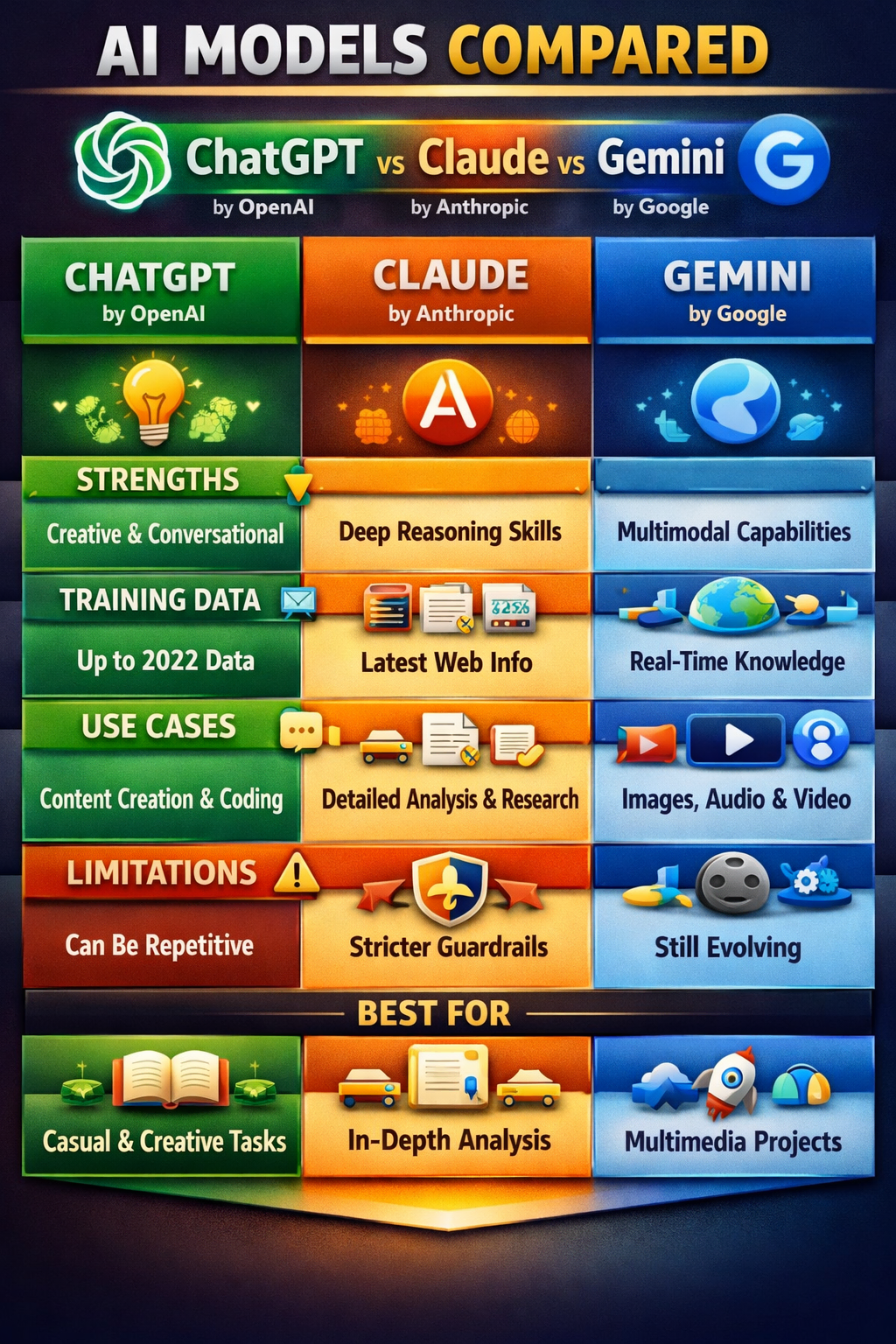
ChatGPT: The Crowd-Pleaser
ChatGPT produces clean, competent writing that rarely disappoints and rarely surprises. Its output feels well-calibrated for professional contexts — polished, structured, and inoffensive. For marketing copy, social media posts, email templates, and straightforward blog content, ChatGPT is consistently reliable.
The weakness is a certain sameness to its voice. ChatGPT tends to follow predictable patterns: three-part structures, moderate enthusiasm, safe vocabulary. It’s excellent at what you ask for but rarely takes creative risks you didn’t explicitly request.
Claude: The Thoughtful Stylist
Claude is widely considered the best AI for writing — and it’s not particularly close. The model produces prose that feels genuinely considered: varied sentence rhythms, nuanced word choices, and a sensitivity to tone that can be difficult to articulate but is immediately apparent when reading.
Unlike ChatGPT, Claude is willing to push back on vague prompts, ask clarifying questions, and take creative risks. Its 200k token context window also means it can maintain coherence across extraordinarily long documents — a genuine advantage for novelists, researchers, or anyone working on book-length content.
Gemini: The Functional Writer
Gemini’s writing quality sits roughly between ChatGPT and Claude. It’s competent and fast, with the added benefit of being able to ground content in real-time information. For data-driven articles, news summaries, or content that requires current facts, Gemini has a structural advantage. For pure prose quality and stylistic sophistication, it trails Claude.
For depth, style, and nuanced long-form writing, Claude consistently outperforms its rivals. ChatGPT is a close second for functional content at scale.
Coding & Development – ChatGPT vs Claude vs Gemini
AI-assisted coding has become one of the most commercially significant use cases for large language models. All three assistants can write, explain, and debug code — but they have meaningfully different strengths.
ChatGPT: Veteran and Versatile
ChatGPT’s coding capabilities are mature and broad. It handles most mainstream programming languages with ease and can execute Python directly in its Code Interpreter environment, making it uniquely good for data analysis tasks that require running actual computations. For beginners especially, ChatGPT’s ability to explain code in plain English while simultaneously producing it is genuinely valuable.
Claude: The Developer’s Choice
In benchmark testing and among professional developers, Claude is frequently ranked as the top AI coding assistant. It excels at writing large, architecturally coherent code blocks — not just snippets. Claude’s extended context window means it can hold an entire codebase in mind when making modifications, reducing the “context loss” that plagues other models on complex projects.
Claude also tends to be better at anticipating bugs, suggesting defensive programming patterns, and explaining the “why” behind code choices — not just the “what.” For developers working on complex systems, this depth of reasoning is worth a great deal.
Gemini: Strong in the Google Ecosystem
Gemini Code Assist (Google’s developer-focused product) integrates directly into IDEs like VS Code and IntelliJ. For developers in the Google Cloud ecosystem, this integration is genuinely valuable. Gemini’s raw coding benchmarks are strong, though real-world developer preference polls consistently place Claude at the top.
For complex, large-scale coding projects and architectural reasoning, Claude leads. ChatGPT is better for quick data analysis tasks that benefit from code execution.
Research & Analysis
Research is where Gemini’s structural advantages become most apparent. The ability to access real-time information is not merely a convenience — it’s a fundamental capability difference.
The Real-Time Advantage
When you ask ChatGPT or Claude about recent events without web search enabled, you’re asking them to draw on training data with a knowledge cutoff. When you ask Gemini the same question, it searches the web by default and synthesizes current information. For research tasks involving recent developments — market trends, news analysis, current events — Gemini has a structural head start.
Deep Analysis: Where Claude Excels
For analyzing documents, academic papers, or large bodies of text, Claude’s superior context window and reasoning depth give it an edge. Load a 50-page research report into Claude and ask for a nuanced analysis of its methodology — you’ll consistently get more sophisticated responses than from the other two models.
ChatGPT’s Data Analysis Strength
For quantitative research — analyzing spreadsheets, running statistical calculations, visualizing data — ChatGPT’s Code Interpreter is a powerful tool that neither competitor matches natively in the chat interface. Upload a CSV file and ask for regression analysis or visualization, and ChatGPT will actually execute the code and show you results in real time.
For research requiring up-to-date information, Gemini’s native web integration makes it the clear choice. Claude wins for deep document analysis; ChatGPT wins for quantitative data work.
Reasoning & Problem Solving
The AI field has developed increasingly sophisticated benchmarks for measuring reasoning ability — mathematical problem-solving, logical puzzles, multi-step deduction, and common-sense reasoning. All three models have improved dramatically in this category.
On major benchmarks like MMLU, HumanEval, and various math competitions, the models perform similarly, with Claude and Gemini often trading the top spot depending on the specific task. What’s more meaningful for most users is the quality of reasoning in practical, real-world scenarios.
Claude’s reasoning tends to be the most transparent — it shows its work, acknowledges uncertainty, and is more likely to tell you when it doesn’t know something. This epistemic honesty is valuable in high-stakes reasoning tasks where overconfident wrong answers can be worse than no answer at all.
ChatGPT’s reasoning improved significantly with the o1 and o3 model family, which use extended “thinking” time before responding. For extremely hard mathematical or logical problems, these reasoning models from OpenAI are among the strongest available.
Multimodal Capabilities
The ability to work with images, audio, and documents — not just text — has become a key battleground in AI assistant competition.
Image Understanding
All three models can analyze images you upload. ChatGPT, Claude, and Gemini can all describe images, extract text from screenshots, analyze charts and diagrams, and answer questions about visual content. Quality is broadly similar, with Gemini sometimes showing an edge on complex visual reasoning tasks.
Image Generation
ChatGPT integrates DALL-E 3 for image generation — you can create images directly in the chat interface. Gemini integrates Google’s Imagen model. Claude does not currently offer image generation. For users who want to both analyze and create visual content in one tool, ChatGPT has the more mature offering.
Voice Interaction
ChatGPT’s Advanced Voice Mode is genuinely impressive — it can maintain natural conversation, detect emotional tone, and respond in real time without the stilted pauses of earlier voice AI. Gemini offers voice interaction with Google Assistant integration. Claude currently lacks native voice capabilities, though this may change.
For the broadest multimodal toolkit — combining voice, image generation, image analysis, and file analysis — ChatGPT offers the most complete package.
Pricing & Free Tiers
The economics of AI assistants matter enormously for most users. Here’s how the three compare.
Free Tiers
All three offer free access. ChatGPT’s free tier uses GPT-4o with some limitations — notably on generation frequency. Gemini’s free tier is generous and includes access to Google’s capable 1.5 Flash model with real-time web search. Claude’s free tier is more restricted, offering fewer messages per day before hitting limits.
Paid Plans ($20/month)
All three premium tiers are priced at $20 per month, which is a remarkable coincidence that likely reflects competitive calibration. ChatGPT Plus gives access to GPT-4o, image generation, Advanced Voice Mode, and more usage. Claude Pro gives access to Sonnet and Opus models with higher usage limits. Gemini Advanced includes Gemini Ultra and Google Workspace integration.
API Pricing
For developers building on top of these models, pricing varies significantly. OpenAI and Anthropic are broadly comparable for API access, with Claude’s Sonnet models offering strong value. Gemini has been aggressive on API pricing, particularly for the Flash models, which offer near-frontier capability at a fraction of the cost.
| Plan | ChatGPT | Claude | Gemini |
|---|---|---|---|
| Free tier model | GPT-4o (limited) | Claude (limited) | Gemini 1.5 Flash |
| Monthly subscription | $20/mo | $20/mo | $20/mo |
| Team pricing | $25/user/mo | $30/user/mo | $22/user/mo |
| Free image generation | Yes (limited) | No | Yes (limited) |
| Best value overall | Good | Good | Best (API) Value pick |
Privacy & Safety
For many users — especially those in professional or regulated contexts — how these companies handle data is as important as raw capability.
Anthropic (Claude): Safety-First Philosophy
Anthropic was founded with AI safety as its core mission. This shows up in Claude’s design: the model is more conservative about producing potentially harmful content, more transparent about its limitations, and more likely to push back on requests it finds ethically ambiguous. For enterprise users in sensitive industries, this philosophy provides a meaningful layer of confidence.
OpenAI (ChatGPT): Improved but Scrutinized
OpenAI has faced significant public scrutiny over data practices and governance — including a notable 2023 leadership controversy. The company has improved its enterprise privacy offerings and offers “ChatGPT Enterprise” with stronger data protections. That said, OpenAI’s commercial pressures are more visible than Anthropic’s.
Google (Gemini): The Data Giant
Google’s core business is data and advertising, which understandably raises privacy questions for some users. Google has committed to not using Workspace data to train its models and offers strong enterprise controls through Google Cloud. Still, users who are fundamentally uncomfortable with Google’s data ecosystem may find this a reason to look elsewhere.
Anthropic’s foundational commitment to safety, combined with strong enterprise privacy terms, makes Claude the choice for privacy-conscious professionals.
You’re new to AI and want one tool that does everything reasonably well. You care about voice interaction, image generation, or data analysis. You want the largest ecosystem and the most widely supported integrations.
You’re a developer, writer, or knowledge worker who values depth over breadth. You work on long, complex documents or codebases. You want the most thoughtful, nuanced AI responses and care about safety and transparency.
You live in the Google ecosystem and want deep integration with Gmail, Docs, and Drive. Real-time information access is critical to your work. You’re building AI-powered products and need competitive API pricing.
The honest meta-advice: try all three. All offer free tiers. Spend a week using each for your actual work. The best AI is the one that fits how you think — and that’s a personal discovery worth making.
